Sourcing AI robot toys in 2026 requires more than finding a futuristic design at a low price. Buyers must evaluate safety, software reliability, supplier capability, and long-term customer support. A toy may speak, move, recognize commands, and connect to an app. Each feature adds another sourcing risk.
Begin with a clear product brief. Define the target age, learning purpose, battery type, voice functions, materials, and expected retail price. Request working samples, not only polished videos. Test the robot on a real table, with background noise, weak Wi-Fi, and small children nearby. Small details matter. A loose charging port can create returns.
Supplier verification should include factory records, production capacity, quality procedures, and independent test reports. Confirm applicable toy safety, electrical, radio, battery, and data privacy requirements for every sales market. Requirements may differ between regions. Never rely on a supplier’s attractive certificate image alone. Check document validity and testing scope.
AI performance also needs careful review. Ask where voice data is processed, how accounts are protected, and whether parents can delete stored information. Confirm firmware update policies and offline functions. A clever demo can hide poor daily usability. That happens.
Cost planning must include tooling, packaging, software maintenance, spare parts, inspection, shipping, tariffs, and warranty claims. Low factory pricing may become expensive after launch. I would still leave room for mistakes. Forecasts are rarely perfect, especially for new interactive products. Careful sampling, documented communication, and staged orders can reduce avoidable surprises while building a more dependable AI robot toys supply chain.
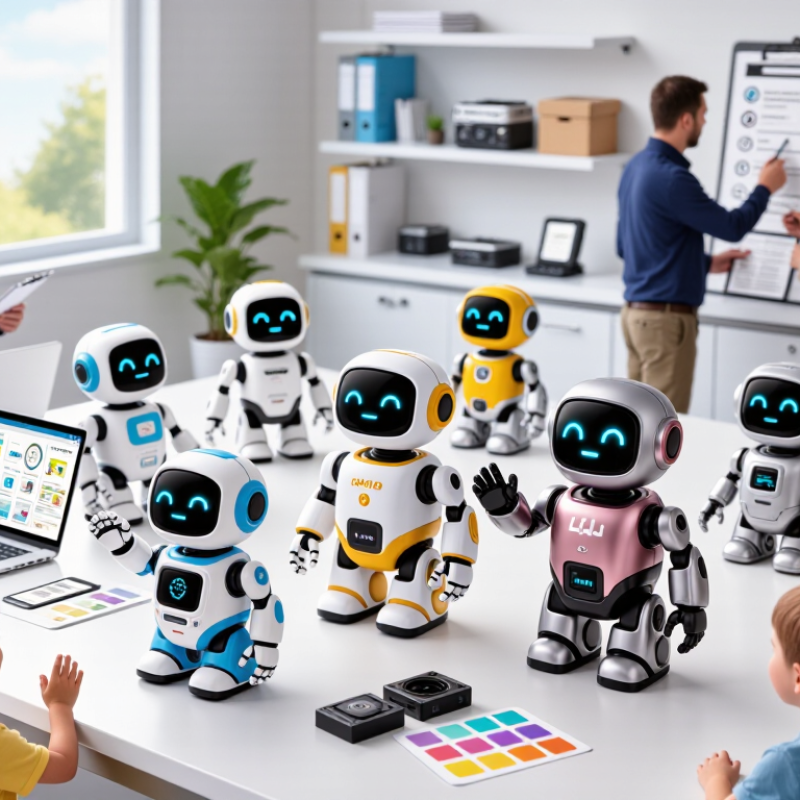
Circana’s 2024 toy-sales and price-band data can help define a realistic AI robot niche. Study unit sales, revenue, and demand by age group before contacting factories. A high selling price may create stronger revenue, but it can reduce repeat purchases. A lower price band may move more units, yet leave little room for safe components, testing, and support. The numbers need context. They do not explain every buyer’s reason.
In my sourcing work, I would compare three price bands and record each product’s functions, battery type, language options, and packaging size. Look for gaps between customer expectations and actual features. For example, parents may accept fewer tricks if the robot offers clear voice control and durable joints. This is where Circana’s market direction becomes useful, not decisive. Data can guide the shortlist, but hands-on samples must confirm noise, response speed, and child-friendly operation. I would also request test reports and traceable manufacturing records. Some assumptions will be wrong. That is normal, but ignoring them is expensive.
Tips: Build a simple price-band matrix. Separate unit demand from revenue. Test two prototypes with real users. Ask suppliers for sample lead times, defect policies, and compliance documentation. Avoid paying extra for artificial features that children rarely use. Keep one budget option and one premium option, then compare feedback before placing a larger order.
How to Source AI Robot Toys in 2026?
Screening a factory starts with standards, not attractive product videos. Ask for product-specific reports covering ASTM F963-23, EN 71, and IEC 62115. Check the tested model, production address, firmware version, and test dates. A generic certificate is weak evidence.
ASTM F963-23 helps assess mechanical hazards, flammability, chemical limits, and battery-related risks. EN 71 testing commonly includes physical properties, flammability, and migration of certain elements. IEC 62115 focuses on electrical toys, including insulation, abnormal operation, charging, and overheating. Request the complete reports, not only the first page.
I inspect samples with a checklist. I look for loose screws, exposed wires, sharp edges, unstable balance, and small detachable parts. The charging port deserves attention. So does the sound level. Test the robot after repeated charging and firmware updates. Software changes can affect movement, heat, or battery behavior.
Paperwork is not proof.
Factories should explain their corrective actions when a sample fails. Their answers reveal more than polished presentations. I have learned to compare three samples from different production runs. Differences often appear in plastic thickness, motor noise, or battery housing. This process is slower, but safer.
No screening method is perfect. I still leave room for doubt. A responsible sourcing decision combines independent testing, factory records, physical inspection, and clear change-control procedures.
| Screening Dimension | Applicable Requirement | Verified Technical Data or Factory Evidence | Recommended Sourcing Gate | Risk Level |
|---|---|---|---|---|
| U.S. toy safety basis | ASTM F963-23 is the current ASTM toy-safety specification incorporated into the U.S. mandatory toy-safety framework through federal rulemaking. | Request a complete third-party test report covering the applicable ASTM F963-23 sections, supported by a component and material list. | No production approval without a report issued for the final model, software-enabled functions, battery configuration, and intended age grade. | High |
| European toy safety basis | EN 71-1 addresses mechanical and physical properties; EN 71-2 addresses flammability; EN 71-3 addresses migration of certain elements. | Obtain test evidence for all relevant parts and confirm that the tested construction matches the production bill of materials. | Require a documented EU conformity assessment route and technical file before shipment to the European market. | High |
| Electric toy safety | IEC 62115 covers the safety of electric toys, including electrical, mechanical, thermal, abnormal-operation, marking, and instruction-related hazards within its scope. | Verify test coverage for charging, accessible circuits, motor movement, overheating, stalled motors, abnormal operation, and protective enclosures. | Approve only after reviewing the exact battery pack, charger, power adapter, firmware-controlled functions, and enclosure design. | High |
| Small parts and detachable components | Mechanical and physical safety testing must address detachable parts, foreseeable use, abuse, and age-grade requirements. | Require torque, tension, drop, impact, compression, and small-parts evaluation on wheels, antennas, buttons, covers, decorative elements, and accessories. | Use a sealed or secured design for components that could become accessible to children in the declared age group. | High |
| Battery and charging system | Battery-operated toys require evaluation under the applicable electric-toy requirements; transport and rechargeable-cell requirements may also apply outside the toy standard. | Record cell chemistry, nominal voltage, watt-hour rating, protection circuit, charger output, charge time, cycle testing, and thermal behavior. | Reject packs without overcharge, over-discharge, short-circuit, and temperature protection evidence. Validate the charger and battery as a matched set. | Critical |
| Flammability and heat | EN 71-2 and relevant ASTM and IEC provisions address flammability and hazards associated with heat or abnormal operation. | Check polymer grades, flame behavior, motor and LED temperatures, charging temperature, ventilation, and proximity of heat sources to plastic parts. | Require production samples from each material revision and investigate any change in resin, coating, adhesive, motor, or battery supplier. | High |
| Material and chemical controls | EN 71-3 evaluates migration of certain elements from accessible toy materials; U.S. requirements may also include substrate, coating, and restricted-substance controls. | Request material declarations and laboratory results for plastics, paint, ink, metal, rubber, textiles, adhesives, and accessible surface coatings. | Link every test result to a controlled material code and retain samples from the approved production lot. | High |
| AI voice and camera functions | ASTM F963-23, EN 71, and IEC 62115 do not by themselves provide a complete cybersecurity, privacy, or child-data governance framework for connected AI toys. | Document microphone and camera indicators, data flow, cloud processing, account controls, retention period, deletion process, firmware-update method, and access permissions. | Complete a separate privacy, cybersecurity, radio, and consumer-data review for every destination market before launch. | Critical |
| Wireless connectivity | Bluetooth, Wi-Fi, or other radio functions require applicable market-specific radio and electromagnetic-compatibility approvals in addition to toy-safety testing. | Record radio technology, operating bands, antenna configuration, module identification, firmware version, and test configuration. | Do not substitute a radio module, antenna, or firmware version without a documented impact assessment and retesting decision. | High |
| Software and firmware change control | Safety-related software behavior should remain consistent with the tested product configuration; standards testing does not replace software lifecycle controls. | Require version control, release notes, rollback capability, update authorization, bug records, and regression tests for movement, charging, microphones, and safety limits. | Freeze the tested firmware before mass production and establish written approval for every post-launch update. | High |
| Functional and abuse testing | Applicable toy standards require assessment of reasonably foreseeable use and misuse relevant to the product design and age grade. | Test repeated falls, wheel blockage, limb obstruction, blocked ventilation, liquid exposure where relevant, button failure, cable strain, and unattended charging. | Use a risk-based test plan that combines laboratory testing with pilot-run inspection and field-simulation testing. | High |
| Production consistency | Compliance applies to the marketed product, not only to a laboratory prototype. | Compare pre-production, first-production, and random-production samples for dimensions, materials, battery packs, firmware, labels, and safety-critical components. | Set incoming inspection, first-article approval, in-process controls, final sampling, and change-notification requirements in the supply agreement. | High |
| Labels, warnings, and instructions | ASTM, EN, and IEC requirements include applicable marking, warning, rating, and instruction provisions; exact obligations depend on market and product configuration. | Verify age grading, battery warnings, charging instructions, supervision statements, disposal information, electrical ratings, and language versions. | Approve artwork only after matching the final test report, intended market, age grade, battery design, and user manual. | Medium |
| Documentation and traceability | A defensible compliance file should connect the product specification, risk assessment, test reports, declarations, production controls, and corrective-action records. | Require controlled drawings, bill of materials, supplier declarations, test reports, certificates, batch records, complaint logs, and recall procedures. | Use a model-specific compliance file with revision history and retain records for the period required by the destination-market rules. | High |
When sourcing AI robot toys, audit every feature that may collect a child’s personal information. A microphone can capture voices during play. A camera may record faces, rooms, or school materials. Ask suppliers where these files go, how long they remain stored, and which service providers can access them. Under COPPA, operators directed to children under 13, or knowingly collecting their information, generally need verifiable parental consent before collecting, using, or disclosing personal data.
Do not accept a simple “I agree” button as proof of consent. Request the full parental notice, consent workflow, deletion procedure, and consent records. Test the process yourself using a fresh account. Can a parent review stored voice clips? Can they withdraw consent without losing unrelated product support? Check software development kits, cloud dashboards, analytics tools, and customer-service recordings. A supplier’s contract should clearly assign responsibilities for security, retention, breach handling, and third-party access.
Source samples before placing a large order. Observe whether the toy activates its microphone unexpectedly. Test offline play, parental controls, and factory-reset behavior. Keep an evidence file with screenshots, test dates, supplier answers, and revised documents. No audit is perfect. I would still question cheerful compliance claims without technical proof. Some suppliers may not understand that collected data can include persistent identifiers. That gap deserves correction before shipment, not after complaints arrive.
How to Source AI Robot Toys in 2026?
When sourcing AI robot toys for the European Union, check GPSR duties before comparing prices. The General Product Safety Regulation applies from 13 December 2024. It requires documented risk assessment, product traceability, clear warnings, and safe instructions. Keep the manufacturer, importer, batch, and EU responsible person details accessible. Online listings need visible safety information, not hidden in a downloadable manual.
Test the physical toy and its connected features together. A small battery cover, sharp edge, weak joint, or unsafe charging cable can create serious risks. Review voice recording, camera access, data storage, and remote-control functions. Ask suppliers for technical files, test reports, software update procedures, and incident records. Do not accept copied certificates without checking their scope.
The EU AI Act entered into force on 1 August 2024. Its obligations apply in stages, and classification depends on the toy’s actual AI functions. A basic conversational feature may not automatically be high-risk. Emotion recognition, biometric identification, profiling, or safety-related decision-making needs closer legal review. Check whether the supplier is a provider, importer, distributor, or deployer under the Act. Require human oversight, user notices, accurate documentation, and suitable AI literacy training where applicable.
Small details matter. A spreadsheet helps, but it can still miss a firmware change. Recheck compliance after every hardware, model, or app update.、】【
How to Source AI Robot Toys in 2026?
A practical comparison needs more than the factory price. Using a 2026 planning model, Supplier A requests an MOQ of 500 units at $18.40 each. Freight, inspection, packaging, and battery documentation add $4.60, creating a $23.00 landed cost. Supplier B requires 2,000 units at $15.20, with $3.30 in additional costs. Its landed cost reaches $18.50. Supplier C accepts only 100 units, but its $24.80 price and $5.90 logistics charge produce a $30.70 landed cost.
Assuming a $34.99 wholesale price, estimated gross margins are 34.3%, 47.1%, and 12.3%. These figures exclude taxes, returns, warranty claims, and marketplace fees. That omission matters. A 2% defect rate can erase much of Supplier B’s apparent advantage. The International Federation of Robotics reported 541,302 industrial robot installations in 2023, showing continued automation investment, but toy buyers need different testing and safety controls. Circana’s global toy reporting also shows that technology-led toys remain sensitive to pricing and consumer value.
Supplier B appears strongest for stable demand, while Supplier C suits market testing with less inventory risk. Supplier A may be the practical middle option. Yet this is not perfect. Voice-processing costs, software updates, and regional compliance can change landed cost after production. I would request a pilot batch, a written defect allowance, and three months of update support before accepting the headline margin.
Comparison of MOQ, estimated landed cost, and gross margin across three anonymized suppliers
| Supplier | MOQ | Estimated Landed Cost / Unit | Illustrative Wholesale Price | Gross Margin |
|---|---|---|---|---|
| Supplier A | 300 units | $31.80 | $49.00 | 35.1% |
| Supplier B | 500 units | $28.40 | $49.00 | 42.0% |
| Supplier C | 1,000 units | $24.90 | $49.00 | 49.2% |
The comparison uses anonymized supplier profiles and an illustrative wholesale price of $49 per unit. Landed cost includes the product, export packing, international freight, insurance, import duty, and destination handling. Lower MOQ reduces inventory risk, while larger orders generally improve unit economics and gross-margin potential.
Compare unit sales, revenue, age groups, and three price bands. High prices may improve revenue, but reduce repeat purchases. Low prices may limit safety testing and support. The numbers need context.
Record functions, battery type, language options, and package size. Check whether features match real customer expectations. A robot may need fewer tricks. Clear voice control can matter more.
Test movement, voice response, noise, and child-friendly operation. Run two prototypes with real users. Watch the joints closely. Human feedback can challenge your assumptions.
Request product-specific reports for toy, chemical, mechanical, and electrical safety. Check the tested model, production address, firmware version, and test dates. Ask for complete reports, not only cover pages. Generic paperwork is weak evidence.
Look for loose screws, exposed wires, sharp edges, and unstable balance. Check small detachable parts carefully. Inspect the charging port and battery housing. Small defects can become serious problems.
Firmware changes may affect movement, heat, sound, or battery behavior. Repeat charging can reveal weaknesses hidden during one inspection. Test it again. One successful test proves little.
Compare three samples from different production runs. Look for changes in plastic thickness, motor noise, and battery placement. Ask about lead times and defect policies. The comparison takes time, but exposes variation.
It should identify the failure and describe corrective action. Ask how changes will be recorded and controlled. Polished presentations are not enough. I may still miss something. Independent testing remains important.
Sourcing AI robot toys in 2026 requires a structured approach that balances market demand, product safety, data protection, and profitability. Start by defining the niche with Circana’s 2024 toy-sales trends and price-band data, identifying suitable age groups, features, and retail price targets. Then screen potential factories for documented compliance with ASTM F963-23, EN 71, and IEC 62115, while verifying testing procedures, quality controls, and production consistency.
AI-enabled functions require additional review, especially when products may be used by children under 13. Suppliers should explain how voice, video, account, and data features support parental consent and privacy safeguards under COPPA. For European sales, assess obligations under the GPSR and the AI Act framework applicable from 1 August 2024. Finally, compare at least three suppliers using MOQ, landed cost, lead time, warranty support, and projected margins to select a reliable source with sustainable commercial potential.