An AI robot dog is more than a four-legged machine. It combines cameras, depth sensors, motion sensors, onboard computing, and software that helps it interpret its surroundings. As it walks across a warehouse floor or climbs uneven steps, it estimates its position, adjusts its balance, and chooses where to place each foot. That response happens repeatedly, often in real time. The result can look surprisingly natural. It can still stumble.
The International Federation of Robotics reported nearly 158,000 professional service robots sold in 2022, a 48% increase over the previous year, in its World Robotics 2023 report. The figure covers many kinds of service robots, not robot dogs alone. It nevertheless signals growing demand for machines that perform practical tasks beyond factory assembly. NVIDIA founder and CEO Jensen Huang has described the broader shift as “the next wave of AI is physical AI.” An AI robot dog brings that idea into the physical world: software must respond to real surfaces, changing light, obstacles, and sensor errors.
How does it work? Sensors collect data; perception software identifies objects and terrain; planning systems select a route; and motors carry out each movement. Some models also use remote control or cloud tools for inspection and mapping. Their capabilities depend on hardware, training, and the environment. A polished demo does not prove reliable performance in every workplace. Understanding those limits matters as much as understanding the technology.
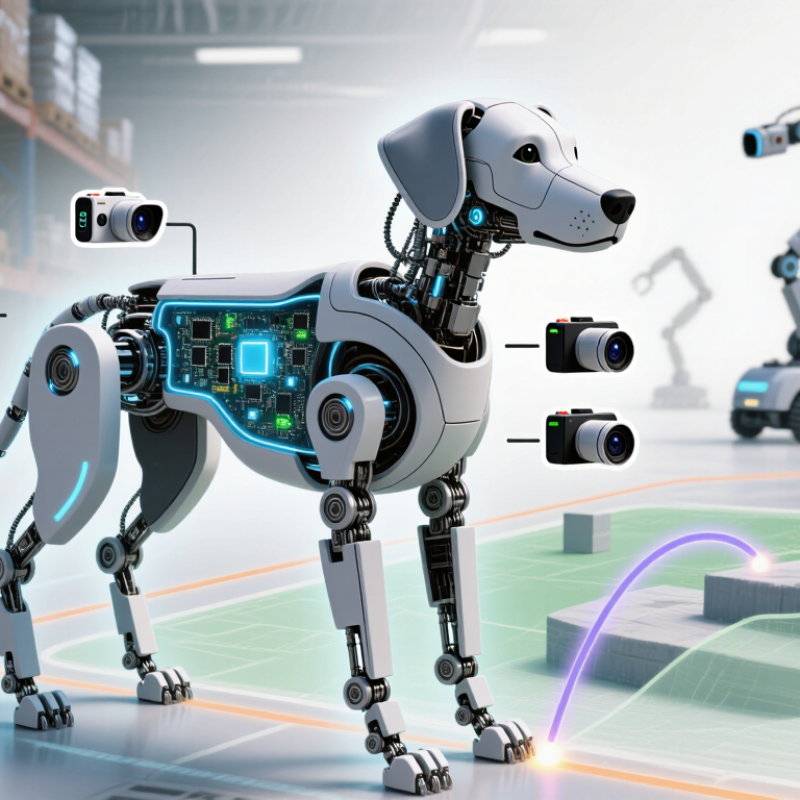
An AI robot dog is a four-legged machine that uses sensors and software to interpret its surroundings and choose some actions. It may walk across uneven floors, avoid a chair leg, or respond to a spoken cue. Unlike a simple remote-controlled toy, it can make limited decisions without a person directing every movement. The label can be fuzzy, though: some machines called AI robot dogs mainly follow programmed routines.
Its body usually combines cameras, depth sensors, microphones, and motion sensors. These gather information about nearby objects, sound, and the robot’s own balance. A computer processes that input and sends commands to motors in the legs. When one foot slips, for example, the robot may adjust its posture or place another foot more carefully. It is still not “understanding” the room like a person. It is matching sensor data to patterns and programmed responses.
Capabilities depend on the model and conditions. Dim light, clutter, loose rugs, or a loud room can confuse sensing systems. A robot may pause, take a crooked step, or need an operator’s help. That limitation matters. AI can make movement more adaptive, but it does not guarantee reliable judgment or safe behavior in every setting. A useful test is simple: watch whether the machine can explainably handle a small obstacle, then see where it struggles.
Robot dogs use sensors to gather information, then software interprets it to help control movement. An RGB camera provides three color channels, an inertial measurement unit (IMU) commonly measures three accelerometer axes and three gyroscope axes, and a joint encoder reports one position value per joint. These are examples; sensor setups vary between robots.
An AI robot dog combines a walking chassis with sensors and onboard computing. Electric actuators move its legs, while joint encoders track each step. An inertial measurement unit senses tilt and acceleration. Cameras and depth sensors help detect stairs, walls, and nearby people. Some models also use lidar or microphones, depending on their intended tasks. The battery powers both movement and computation, so heavy sensing can shorten working time. A real trade-off.
Software turns those signals into action. Perception systems identify objects and estimate distance; mapping and localization software help the robot understand where it is. Motion-planning algorithms choose a route, while gait controllers adjust foot placement on uneven ground. The International Federation of Robotics’ World Robotics 2024 report recorded about 205,000 professional service robots sold in 2023, a 30% rise from the previous year. That figure covers many robot types, not just quadruped machines, but it shows growing demand for mobile automation. Reliable systems still need safeguards, such as obstacle stops and battery monitoring. Sensors can misread shiny floors or loose cables. Field testing matters.
An AI robot dog senses its surroundings through several kinds of sensors, not one all-seeing camera. Cameras capture color and shape, while depth sensors estimate how far away objects are. An inertial sensor tracks tilt and movement as the robot walks. Some models also use microphones or touch sensors to detect sounds and contact.
The signals are combined into a changing estimate of the nearby scene. Software can identify common objects, locate obstacles, and compare the current view with earlier observations. It may recognize a table leg, for example, then adjust its path before a shoulder bumps it. It is not magic. A dim hallway, moving shadows, or a shiny floor can still confuse the system. The robot’s estimate is useful, but never identical to human understanding.
Movement adds another layer. As a foot meets the ground, force measurements help the robot judge whether the surface is firm or slipping. Its control system can shorten a step or shift its weight to stay balanced. These decisions happen repeatedly, often within fractions of a second. Still, sensor data can be noisy, and unexpected objects may be misread. Engineers test these limits in varied settings because a tidy laboratory floor does not represent every home or worksite.
An AI robot dog makes decisions by repeatedly sensing, estimating, and adjusting. Cameras identify edges, stairs, and objects; depth sensors estimate their distance. An inertial sensor tracks tilt and rotation, while sensors in the legs detect contact with the ground. The onboard computer combines these signals into a rough picture of the surroundings. It may choose to step over a cable, slow down, or stop. On a polished floor, though, reflections or a loose mat can confuse its sensors. The picture is useful, not perfect.
Movement depends on feedback, not a single preset command. The computer plans a short sequence of foot placements, then electric motors move the joints. If one paw lands unevenly, the robot adjusts its posture and shifts its weight. Not magic. Just feedback. The International Federation of Robotics’ World Robotics 2024 report recorded about 205,000 professional service robots sold in 2023. Around 113,000 served transport and logistics tasks. These figures describe service robots broadly, not robot dogs, but they show how common mobile automation is becoming. A robot dog can still misjudge a slippery patch; careful testing on varied floors matters.
An AI robot dog is a four-legged machine that uses sensors and software to move through its surroundings. Cameras, depth sensors, and sometimes microphones gather information; onboard computers use it to recognize obstacles, estimate position, and choose movements. Electric motors adjust each leg to help the machine climb steps or cross uneven ground. Some models can follow a person, map a work area, or send images to a remote operator. These abilities depend on the equipment and software installed.
Useful, but not magic. In a warehouse, a robot dog might inspect a warm motor or carry a small camera beneath a low pipe. It can also enter places that are awkward or risky for people to reach. Yet dim light, reflective surfaces, loose gravel, and heavy rain may confuse its sensors or slow it down. Battery life limits how long it can work, and a human may need to monitor its route or intervene. It can misread an unfamiliar scene. That distinction matters: recognizing a pattern is not the same as understanding its meaning. Operators should check sensor data, protect recorded information, and test performance in the actual environment. A careful trial can reveal gaps that a polished demonstration may hide.
| Dimension | How It Works | What It Can Do | Limitations to Consider |
|---|---|---|---|
| Definition | A four-legged mobile robot combines mechanical legs, electric actuators, sensors, onboard computing, and control software. “AI” may refer to perception, navigation, or learned control; not every robot dog uses the same methods. | Move through environments on legs and carry out programmed or supervised tasks. | It is a machine, not a biological animal: it does not have animal instincts, feelings, or general human-like understanding. |
| Sensing and perception | Depending on the model, cameras, depth sensors, lidar, inertial measurement units, and joint sensors provide information about surroundings, body movement, and foot position. | Estimate its orientation, detect obstacles, recognize some objects, and build a map when equipped with suitable sensors and software. | Dust, rain, darkness, reflective or transparent surfaces, sensor placement, and crowded scenes can reduce perception quality. Sensor capabilities vary by system. |
| Locomotion and balance | Motors move the legs while control software adjusts foot placement and body posture. Feedback from onboard sensors helps it respond to motion and changes in terrain. | Walk, turn, and—in systems designed for it—climb some stairs or cross uneven ground. | Steep, loose, slippery, narrow, or unstable surfaces may be difficult. A fall, obstacle, or loss of traction can stop or damage the robot. |
| Navigation | Mapping and localization software can compare sensor readings with a map or nearby features to estimate the robot’s position and plan a route. | Follow waypoints, patrol a defined area, or navigate around detected obstacles in suitable conditions. | Navigation can be less reliable in changing, unfamiliar, GPS-denied, or cluttered environments. Human supervision may still be needed. |
| Inspection and data collection | Payloads such as cameras, thermal imagers, or other task-specific instruments can collect measurements while the robot moves. | Inspect accessible industrial or infrastructure areas and transmit images or readings for a person to review. | It does not automatically make a correct diagnosis. Data quality, sensor calibration, access, and expert interpretation affect results. |
| Remote operation and autonomy | Operators may control the robot remotely, assign routes, or let onboard software handle parts of movement and navigation. | Perform repeatable routes or operate in places that are inconvenient or risky for people to enter. | “Autonomous” usually describes specific functions, not unrestricted independent decision-making. Connectivity, setup, and human oversight may be required. |
| Manipulation and payloads | Some systems can carry equipment; a smaller subset can use an added arm or other tool. These functions require compatible hardware and control software. | Transport lightweight equipment or perform limited, task-specific interactions when properly equipped. | Carrying capacity, balance, battery use, and precision constrain tasks. A standard quadruped cannot grasp or manipulate objects without suitable attachments. |
| Power and operating time | Rechargeable batteries power the motors, computers, and sensors; demanding movement and added payloads consume more energy. | Work for a period between battery changes or recharges, depending on workload and system design. | Operating time is finite and varies with terrain, speed, payload, temperature, and battery condition. Charging or battery replacement interrupts work. |
| Safety, privacy, and security | Safe deployment can involve speed and force limits, emergency stops, access controls, secure communications, and clear operating procedures. | Support supervised work while keeping people informed about when and where the robot is operating. | Moving machinery can create collision or pinch hazards. Cameras and network connections also raise privacy and cybersecurity concerns if poorly managed. |
| Overall suitability | Performance depends on the robot’s hardware, software, task, environment, maintenance, and operator training. | Best suited to defined tasks where mobility or remote data collection offers a practical benefit. | They are not universal replacements for people, and they may be costly or impractical when a simpler sensor, wheeled robot, or human inspection is sufficient. |
Note: Capabilities differ across systems. The examples above describe common design approaches and should not be taken as guarantees for every AI robot dog.
Cameras capture color and shape, while depth sensors estimate distance. Inertial sensors track tilt and movement. Some models also use microphones or touch sensors.
Its computer combines sensor signals into a changing estimate of the scene. It may identify a table leg and adjust its path. It is not magic.
No. It can recognize common objects and compare views over time, but its estimate is limited. Shadows and dim hallways may cause confusion.
Sensors detect foot contact and forces on the ground. The robot can shorten a step or shift its weight when a surface feels unstable.
It plans short sequences of foot placements using information about edges, stairs, and objects. It may step over a cable, slow down, or stop.
Feedback helps the robot adjust its posture and move its weight. Motors then change the joints. Not always.
Yes. Reflections, loose mats, or slippery patches can mislead sensors. Testing on varied floors matters, since a tidy laboratory is not every environment.
It repeatedly senses, estimates, and adjusts, often within fractions of a second. Sensor data can still be noisy, so its choices are not flawless.
An AI robot dog is a four-legged machine designed to move through spaces and respond to its surroundings. It combines mechanical parts, sensors, and artificial intelligence to perform tasks that would be difficult for a simple remote-controlled toy. Its hardware may include a sturdy frame, motors at the joints, cameras, distance sensors, and a battery. Its software processes sensor readings, recognizes patterns, and helps coordinate movement.
As it explores, the robot can estimate distances, detect obstacles, and build a basic understanding of nearby objects and terrain. It uses this information to choose actions, such as slowing down, changing direction, or adjusting its balance. AI robot dogs can assist with inspection, research, demonstrations, and other tasks in places that may be hard for people to reach. However, they do not understand the world as people do. Their performance depends on their sensors, programming, battery life, and operating conditions, and they may struggle with unfamiliar environments or unexpected changes.